Watch out for this planning pitfall at the start

So let’s assume that we have a receptive Village Administration (!) and enough interest in the community that we’re going to tackle a project of benefit to us. We can have bucketfulls of enthusiasm and volunteers with extensive “project management” experience, and STILL end up with something which looks good on paper but just doesn’t work. (Like the many failed “Pedestrian Plazas” in downtowns all over the country.)

How can this happen? Simple… by not utilizing people who are trained, experienced, and qualified in civic design, with understanding of the myriad processes and functions which go into design well-functioning “places”.

This is similar to utilizing an architect to help design a home as opposed to selecting a house design from a book full of hundreds. The services of an architect will typically add 3% – 5% to the cost of the home, but the end product will be a much better fit to the needs of the occupants. Hiring a design firm with extensive experience in building typical commercial projects, but not possessing the correct mindset to design and build for the “long-run” results in yet another project which has everyone asking themselves afterwards “Where are all the people who were supposed to be here?”. [The “7P Rule” applies here!]

Simple project planning asks:

“What would you like to see here?”

And there it is. Perhaps the most inane question ever posed in the course of a public design process. And posed it is, constantly.

“We’re doing a master plan for downtown. What would you like to see here?”

It’s crazy. In one sweeping question, practitioners not only set the stage for unmet expectations, they devalue the art and craft of urban design at the same time.

We need to do better. We need to more effectively play the role of psychoanalyst, drilling down to information that’s actually useful: What kinds of things would residents like to be able to do? What problems would they like mitigated? What potential byproducts of change are they afraid of? How can your city better serve you?

Are they using a “cookie-cutter” approach to deciding what-goes-where, or are they actually “planning”?
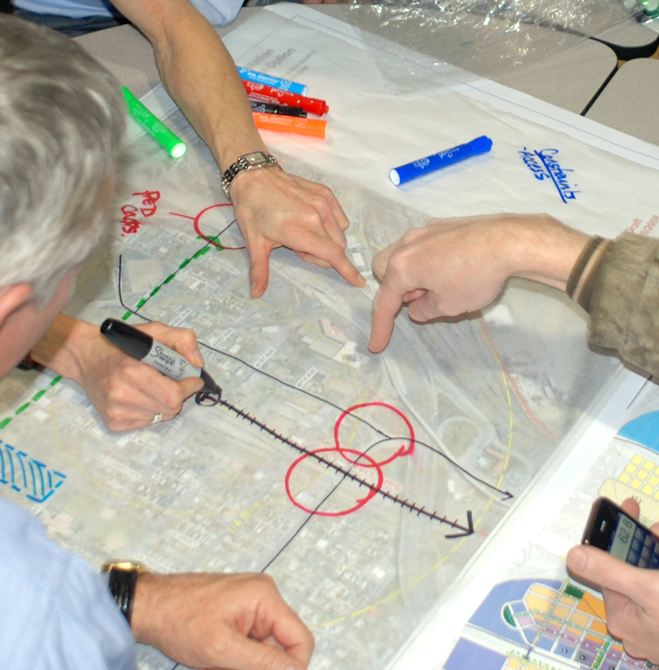
Are they using a “cookie-cutter” approach to deciding what-goes-where, or are they actually “planning”?

Instead of asking for specifics, like a bookstore, coffeeshop, park, etc., designers work with residents and local officials to examine what is working and what isn’t in the local dynamics, then even deeper to determine WHY? A well-meaning 1970’s solution to provide local retail opportunities and contribute to the tax-base could have in itself created multiple problems down-the-road.

When we seriously get going in RLB to build a Village identity, some sort of workable civic “place” with useable, desireable public space which serves a wide variety of users, let’s make sure we do so with someone who isn’t just hyping quick-to-build, low return-on-investment schlock, or a bunch of specific businesses and building types which don’t work together or address our real needs.

When we ask, “What would you like to see here?”, we suggest that all ideas have comparable merit… that they’re all equally worthy of implementation, even though we know that’s not the case.

We lead people to believe that if they ask for a library, there will be a library, regardless of whether or not one’s needed. Or budgeted. Or carries with it the necessary political will to become real. We draw the requested coffee shop or grocery store, with no consideration of market demand or the fact that the city plays no role in leasing decisions.

Most people are not experts in design. But they are experts in their own lives. Understanding their wants, needs and concerns, and then addressing them through responsive, reality-based design, is ultimately what the public process should be set up to do.

Full article: Public Process and the Perils of Dismissive Engagement
Posted in Planning | Leave a comment

The sorry state of neighborhood design in America: a mother writes

Article Link: The sorry state of neighbourhood design in America: a mother writes

I am German, have lived in the US for 18 years and have raised three children here. I very much miss the German way of being able to let my child go outside by himself, or walk anywhere from our home. I find the infrastructure very car oriented.

Distances, as well as property sizes are considerably larger, thus there is hardly any bike paths, but 80% large roads. Hey, even a small town has double the width roads that you would find in any German town, so traffic is much more unpleasant. The sight is usually anything but inviting if I compare it to bike paths I know from back home. Same for distances, with everything just soooo stretched out.

I do see very gratefully a movement here in the US by architects, trying to rethink communities and how to build them more “inhabitants friendly.” Car joy is not everything. Community is built by people passing each other in the streets, by NEIGHBORhoods, not “stranger”hoods. I never felt so disconnected from other people as I do here in my life in the US. And I do believe the way communities are built plays a BIG role in this.

Also having more green spaces everywhere, planting trees along roads (the green lung has always been a respected issue in German city planning), reducing distances between people, or at least creating social areas within any of these neighborhoods. Also, how about a playground, WITH nature: shrubs, trees, boulders, tree stumps, etc – not only school playgrounds – incorporated in all those estranged neighborhoods? It would draw people back out and together, and help overcome the hurdle of keeping your children from going by themselves into the “unknown”.

Make sure to check out the reader comments at the end of the article!

Posted in Bicycling, Planning, Walkability | Leave a comment

Wheeling adopts plan for improving walking, biking and access to transit

Definite signs of a community which has places worth walking and biking to, which values them, and wants to make a good situation even better! The folks over at the Active Transportation Alliance tell us what’s happening in Wheeling IL:

“Congratulations to the Village of Wheeling for adopting an active transportation plan!

 Nearly 250 people from the north suburban community helped shape the plan: Local residents, business owners, elected officials, and representatives from the schools, park districts, bike clubs and community organizations all provided valuable feedback. 

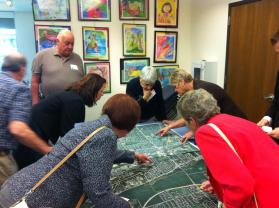
Wheeling residents planning for better walking, biking, and transit

Wheeling residents planning for better walking, biking, and transit

The plan contains guidance on where improvements for walking and biking are most needed, what types of improvements to make, policies to encourage coordinated planning of future bike and pedestrian facilities, maintenance plans for existing facilities, and programming ideas for encouraging people to walk and ride in Wheeling. It’s all there!”

It’d be tough to jump right to something like that in Round Lake Beach, since the prevalent mindset is so in-favor of cars by default (as if the Village was designed that way… oh wait, it WAS).

Getting some more of us fired-up though, and voting-in a couple of forward-thinking “let’s give it a try” Trustees can help get the ball rolling.

Link to full article: Wheeling adopts plan for improving walking, biking and access to transit

Posted in Bicycling, Planning, Transit, Walkability | Leave a comment

Webinar: “How Can a Microbrewery Grow Your Local Economy?”

Webinar: “How Can a Microbrewery Grow Your Local Economy?”
When: Thurs, Jan 10, 2013 @ 10am CST
Cost: $95 for IEDC members, $135 for Non-members

Q: Did any of our Village officials, or anyone in the Chamber of Commerce utilize this resource?

“Microbreweries offer substantial opportunities for communities. Not only do they allow for re-using vacant space, they also create local jobs; attract new companies or expand existing ones; and increase the tax base.

Sampling events are VERY popular

Sampling events are VERY popular!

Attend our web seminar on Economic Beer Gardening and:

• Hear from the perspective of a microbrewer, the steps that an economic development professional can take to attract and support microbreweries to their community.

• Learn from detailed new data that supports the strong economic impact of microbreweries, including growth potential, job creation, and growth in tax revenue.

• Understand the importance of place-making in nurturing microbrewery growth and how to capitalize on the success of microbreweries in your community.

• See how buzz created from local breweries can impact everything from tourism to research at your local university; lessons learned by our experts can help you as you explore microbreweries potential in your community or look to capitalize on those already pouring pints and growlers.”

Libertyville, Mundelein, and Grayslake all have micro-breweries/brew-pubs  operating as retail establishments, and now Lake Zurich is strongly considering a micro-distillery operating on the same model (and make note that “The distillery’s business model was presented as a destination and tourist attraction“).

In the US, our relationship with alcohol has frankly been rather weird since Prohibition. There are still some “Village Elders” who see all things alcohol as “Eeeee-vil!” , and can barely tolerate the concept of allowing any local eatery to serve alcohol in an outdoor seating area (much less actually CREATING alcohol within village limits).

In the mean-time, tastes change, home-brewing and wine-making experience tremendous growth (two new businesses opened recently in Lake Co to support demand: Gurnee and Libertyville), more consumers want to support local businesses and keep money in their communities, etc., etc.

What do YOU think? Can we support something like a brewpub in the Round Lake area? Can it be the basis to revitalize an area, or should it go to someplace which already has “life”? When you picture a brewpub, what else do you picture nearby?

Link to: How Can a Microbrewery Grow Your Local Economy?

Posted in Meeting / Webinar, Planning | 1 Comment

Creating the right conditions to invite investment

Time to visit Grayslake again, and see how recent circumstances there compare to Round Lake Beach. (Of course, no two villages should strive to be identical, but there are always many aspects in common among successful municipalities since they all [should] serve the same core functions.)

—————————————————————————————————–

Article Links:
– Lake County News Sun Article: “Last Chance Saloon sold to longtime restaurateurs
– Grayslake Patch: “Last Chance Saloon Closes

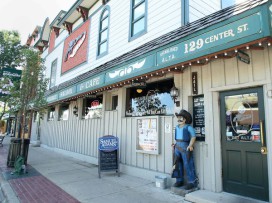
The Last Chance Saloon, on Center Street, operated for almost two decades as a centerpiece of the community until being recently purchased by new owners. New-owner transactions like this occur all the time based on needs of the owners, zoning/ordinance compliance costs, purchase by investment groups, entrepreneurs making a start… lots of reasons.

Image

The new owners in this case are experienced and successful restaurateurs in Lake County, including owning and operating Emil’s Tavern, which is just east of the Last Chance.

Here’s what’s interesting: With eateries in Grayslake, Mundelein, and Ivanhoe, the new owners could certainly have diversified with a location in still another community… yet they chose to make a go of a restaurant basically right next to one they already have!

Why would they take such a chance doubling-up in the same town? And why the heck wouldn’t they come up and give it a try in Round Lake Beach? Here’s what they have to say:

“We were looking at going elsewhere to start another business, but we really enjoy doing business in Grayslake.

Grayslake is a great community, very vibrant, it has a good downtown, and we’re glad we’re there.”

They say a lot in just two sentences, don’t they? Can Round Lake Beach offer anything more than just vacant units in our strip lots and shopping centers to potential new business owners willing to invest in central Lake County? It’s as if we don’t realize that there’s an entire CLASS of businesses which specifically DON’T WANT to locate in “sprawl”. We offer no other alternative for them (because of poor planning decades ago)… so they find their settings elsewhere:

  • settings which don’t require acres of parking,
  • which are friendly to customers driving/walking/biking,
  • settings with lots of different business, attractions, and things to do/see in close proximity
  • which can attract spur-of-the-moment customers with delicious aromas wafting out the door, or tempting peeks of the fun and food inside through the picture windows lining the sidewalk,
  • which can support al fresco dining (something at which RLB is especially challenged),
  • which can integrate into the streetscape and events which happen there (street fair, farmers markets, etc.),
  • where… well, you get the idea!

To get places that people value, we need to focus on creating the conditions for success. We have endless examples from around the world which show us the universal desirable elements common to small towns and villages… elements which are not allowed under current Zoning! Those design features and aspects (which used to be more common knowledge) have us joyfully exploring the village squares, small shops and back-alleys of virtually any small town in Europe. [It turns out that when you’re building brick-by-brick, with manual labor, you do a LOT a planning of what to build, where, and why!]

With little build-able land remaining, Round Lake Beach MUST plan BEFORE it grows any more, with help from actual qualified urban/village planners, who can do more than design strip malls and shopping centers, and understand the many dynamics of successful communities. Our single-use zoning model is totally unsuited for village planning, and the 2009 Master Plan is based on it! To get “good density” in a welcoming, multiple-use village center we must start with Form-Based Codes!

Posted in Economics, Planning | Leave a comment

Webinar: “Streets as Places”

Webinar: “Streets as Places”
Speakers: Gary Toth (Senior Director, Transportation Initiatives, Project for Public Spaces) and Kate Rube (Transportation Program Manager, Project for Public Spaces)
When: Tues, Dec 18 2012 @ 1pm CST
Cost: Free (but advance online registration IS required)

Q: Will any of our Village officials utilize this free resource?

This webinar will focus on opportunities to create streets that are not only good for mobility, but are also public spaces and destinations in their own right. Speakers will present case studies that range from revitalized Main Streets, street plazas and parklets, and flexible street designs that allow for festivals and celebrations.

Across the country, communities are realizing the value of vibrant streets and districts that support local commerce and culture. This webinar will focus on how planning for streets as places—in the right context—can also improve traditional performance measures (safety, throughput and travel time) as well.

Brought to you by FHWA, in partnership with the Project for Public Spaces (PPS), and the INDUS Corporation.

Link to more info and registration: “Streets as Places” Webinar

Posted in Meeting / Webinar, Planning | Leave a comment

Hey Dude… where’s our Downtown?

At a recent event held as part of the Round Lake Beach 75th Anniversary Celebration, I was partnered with a former RLB mayor. As volunteers, we were both scheduled to staff a given check-point/display for 4½ hours.

As a long-time area resident, he was VERY knowledgeable in the history of the area, the development of Round Lake Beach in particular (having been the Mayor helped with that!), whereas I wanted some in-depth perspective as to how things came to be. What a perfect opportunity for a meeting of the minds!

I had only ONE question for which I was seeking an specific answer: just WHERE was downtown Round Lake Beach supposed to end up in the “Grand Scheme” of things?

You see, among his other accomplishments, this former mayor was responsible for much of the retail “growth” in our village during the 80’s and 90’s. He was in a perfect position to ensure that RLB would not be taken advantage of by fast-taking developers. Being a small, land-challenged village, pre-planning of any development was much more critical than in nearby larger villages which (by comparison) had land to spare for less productive single-use sprawl-centric projects like strip malls and shopping centers at their outer edges.

[The section where you are spared 4½ hours of details…]

So, where was the “downtown” of Round Lake Beach supposed to go?

Sorry to say, it was never supposed to go anywhere. The focus was on fast growth for purposes of increasing tax revenue and giving residents local shopping opportunities. The idea of consulting with actual experienced village PLANNERS to create a multi-use, dense-with-retail, walkable downtown district and civic/public space (even if only a few blocks long) in the last remaining suitable area was shelved in favor of the Ponzi Scheme of short-term growth.

Turns out that the “Zoning” which was being used for overall guidance was developed with suburban expansion in mind; it was completely unsuitable for use in creating/supporting a mixed-use city center where the many facets of civic and community life can actually happen.

… and that’s why we have strip malls and shopping centers where our downtown is supposed to be!

Posted in Economics, Planning, Walkability | Leave a comment

The “Greying” of Round Lake Beach: Are we ready?

(More than 13 percent of the US population is over 65, and by 2030, that figure will be 20 percent. Many of those Baby Boomers plan to “Age In Place“, and many others will move… to smaller houses or multifamily buildings but within the same town. With the changes in healthcare and lifestyle, they are living better and longer than their predecessors. Is RLB ready now for this shift in demographics… will we be ready THEN?)

“Two generations of older adults aged 65 and above now occupy our suburban settlements—especially in our “first tier” or inner suburbs, those built just before World War II, and during the rapid suburban growth of the 1950s and early 1960s.  Our suburbs will become home to yet another generation of older adults when the oldest baby boomers begin to celebrate their 65th birthdays.”

More of today’s seniors are active and involved in their communities, many continuing to work past their retirement. As they age, they are choosing to do so in their homes while also retaining priceless relationships with nearby family and friends.

“Ongoing survey results from AARP conclude that most older adults are satisfied with where they live and prefer not to move. They feel emotionally attached to their residential settings and treat both their dwellings and their personal possessions as archeological evidence of their memorable past lives. Because they are longtime occupants, they typically have a well-established social network, know how to navigate their communities, and are reluctant to pick up stakes and start new lives in unfamiliar places.”

From their homes, they like to walk, ride bicycles, have easy access to parks and markets, and many will seek mixed-use places. The nation will need more active-living, and more complete, communities to accommodate this massive demographic shift. That probably means a Walk Score of at least 70, in a safe neighborhood, ideally with access to transit.

“Epidemiologists are reporting a link between suburban living and physical health. They find that older people walk less frequently when they live in lower density neighborhoods that are more distant from shopping, restaurants, and other services. They also get out less when their neighborhoods have social disorders such as poverty, intimidating strangers, and crime. Absent or poorly designed and maintained sidewalks (e.g., uneven or interrupted walkways, poor street lighting, absent benches, dangerous crossings, and hilly terrains) also limit their mobility as pedestrians. Additionally, they find that older people with more limited walking opportunities are at greater risk of being obese.”

As attractive as the idea of aging in place may be, progress in this direction has been slow and uneven. Towns and cities that have been built for “Automobiles First and Forever!” are not very friendly to older residents, especially those who can no longer drive. Downtowns are often not very accessible; public transit is spotty or nonexistent in many cities, and sidewalks are an after-thought.

With the poor economy, families are again moving the generations back together (which used to be the “norm”, and was a primary way civilization and culture were passed down from generation-to-generation) so “grandma can watch the kids” while mom and dad work outside of the house. Our newer homes are NOT multi-generationally friendly, being designed for healthy families with healthy kids: few with 1st-floor bedrooms & full bathrooms, not designed with expansion in mind, often multiple interior levels with extra steps, vanities which cannot accomodate wheelchairs (or even “walkers”), and of course they’re not convenient to “Main Street” where able-bodied seniors could walk or bike to the cafe, barber shop, coffee shop, market, or a volunteer opportunity.

Likewise, our older housing (much of which was not designed for year-round living) is poorly insulated, has ancient heating and cooling equipment, often not up to modern codes for safety, and lacks sidewalks.

We also limit our options by having very little housing which could become “co-housing” for seniors, typically larger homes which are divided up into apartments. Our Park District’s program for seniors isn’t even in our village, the largest in the Round Lake area.

So, how are we doing? Does our 2009 Comprehensive Land Use Plan address making effective use of the remaining buildable land to enhance connectivity and access, or in-filling existing properties to improve their function? Are the Building Codes being reviewed to make it easier to modify structures? It’s nice to have the new Oak Hill Senior Supportive Living Center in town (conveniently next door to “Advance Auto Parts” and “Thornton’s“), but what of all the seniors with small paid-for homes that don’t want to cash-out and move-out to use it? Are our social-service agencies and community/church groups ready for more seniors and their needs?

Ironically, the factors which make a municipality more senior-friendly benefit EVERYONE over the long-term, no matter how good or bad the economy is doing!

Link: Aging in the American Suburbs: A Changing Population
Link: Great Ideas for Senior-Friendly Communities

Posted in Economics, Planning, Seniors | Leave a comment

“10 Benefits of Creating Good Public Spaces”

There is a value beyond the obvious to creating “places that work“. We’ve all seen the results of well-intentioned plans which do not seem to deliver as promised; this includes the uber-controlled world of “Happy Consumerism”, endless cheap energy,  and automotive excess envisioned in the modern Zoning Codes.

An isolated strip-mall, with its back turned to the nearby subdivision (followed by the insult of a 6′ tall privacy fence with no gates along the entire length of the commercial property) looks great on paper to the planners, represents “growth” to small-town politicians, and is an easy build for developers.

Unfortunately, in practice, it doesn’t at all support how we have “lived” in our cities and villages for MILLENIA. As we grow look towards options for helping make Round Lake Beach a better place to live, let’s remember the key concept which is so opposed by use-based Zoning and those who support it: INTEGRATION!

1.  Support local economies
2.  Attract business investments
3.  Attract tourism
4.  Provide cultural opportunities
5.  Encourage volunteerism
6.  Reduce crime
7.  Improve pedestrian safety
8.  Increase use of public transportation
9.  Improve public health
10.  Improve the environment

Our local public officials, previous and current, are not trained in civic planning and land-use management… or re-working communties suffering the results of poor decisions in the past. This can also prevent them from seeing the possibilities; “doing it right” on acres of undeveloped land isn’t the only way to fix some of our infrastructure problems. (In fact, being largely “built-out”, Round Lake Beach doesn’t really have much of an option to build from scratch anymore…)

LINK: “10 Benefits of Creating Good Public Spaces

Posted in Economics, Planning | Leave a comment

“The Five C’s of Neighborhood Planning”

As we look for ways to improve of neighborhoods, each with its own strengths and challenges, here is a brief look at some of the common elements found in neighborhoods that work.

Examine your own neighborhood… what category of functionality faces challenges? Is it isolated and disconnected? Do you HAVE to drive ALL the time just to get to someplace else for even the most basic ammenities? If you and your neighbors wanted to have a community event or gathering… could you?
———————————————————————————————–

The Five Cs of Neighborhood Planning

The neighborhood is a physical place — varied in intensity from more rural to more urban — that many different communities inhabit. At its essence, whether downtown, midtown or out-of-town, its health and viability (in terms of both resilience and quality of life) is defined by certain basic characteristics. Easily observable in neighborhoods that work, these characteristics have been articulated a variety of ways over the years. Combined, they form what I like to call the 5 C’s.

 1. Complete

Great neighborhoods host a mix of uses in order to provide for our daily need to live, work, play, worship, dine, shop, and talk to each other. Each neighborhood has a center, a general middle area, and an edge. The reason suburban sprawl sprawls is because it has no defined centers and therefore no defined edge. Civic spaces generally (though not always) define a neighborhood’s center while commerce tends to happen on the edges, on more highly traffic-ed streets and intersections easily accessible by two or more neighborhoods. The more connected a neighborhood is, the more variety of commercial goods and services can be offered.

MORE: “The Five C’s of neighborhood Planning

Posted in Economics, Planning | Leave a comment