Webinar: “Building the Walking Movement—New Strategies and Coalitions”

Webinar: “Building the Walking Movement—New Strategies and Coalitions”
When: Tues March 19, 2013 / 1:30pm – 3:00pm CST
Cost: FREE, but online advance registration is required. Login instructions will be sent upon registration!

Webinar #3 in the All Things Walking Series: “Building the Walking Movement—New Strategies and Coalitions”

Webinar Description: “Tune in for a webinar that is informative and interactive!

• “Hear” from presenters who are our partners in the Every Body Walk Collaborative and all working to make America a great place to walk.
• “Tell” us how you and other walking advocates plan to be involved to ensure the success of the National Walking Movement. Time will be allotted at the end of the presentations to hear directly from the audience.”

Link to info/registration: “Building the Walking Movement—New Strategies and Coalitions”

Posted in Meeting / Webinar, Walkability | Leave a comment

“Future Shock” re-visited… cars and Millennials

Do you remember reading Futurist Alvin Toffler’s “Future Shock” and “The Third Wave” back in the 70’s? These books foretold the coming major changes to culture and society based on the explosive rate of technological development. A major point of these books was to help people to understand what was happening, and how to prepare for the coming changes (processing information instead of raw materials, robots in assembly lines, people being replace by computers, etc.).

One of the most notable examples of NOT preparing for the change was the US automobile manufacturing industry. As their world changed rapidly around them, and consumers switched to Japanese-built products, they could/would not let go of their world-view; as a result it took two decades before they became competitive again.

Are YOU like that… at least when it comes to thinking of “change” in Round Lake Beach?

The trap is: the values and expectations of the “Replacement Generation” of home and business owners do not match that of the previous generation. Especially the “chasing the American Dream” values of the “Baby Boomers”.

“Once a week or so we come across yet another sign that Millennials care much less about car ownership than previous generations. They’re less likely to drive than their parents. They’ve got less debt tied up in cars. They’d rather hang out with their friends on Twitter than get in a car to go see them.

And here’s yet another: Ask Millennials which piece of technology they could least live without, and it turns out they’d more happily part with their cars than their computers or cell phones.”

The suburban variety of Millenials has grown-up as chauffered “commuter kids” needing to be driven everywhere, in sub-developments all across the country which were built for maximum throughput of cars-per-hour, with no place to just “hang out”, seeing both parents HAVE to work in order to pay for the McMansion and the SUVs.

In the meantime, they’ve grown up connected AND exposed (in a good way): They’ve watched TV series, documentaries, and videos from all over the world showing people happily living in cities without having cars at all (think “Friends” and “Seinfeld“). They have grown up hearing about problems with pollution and dwindling energy supplies, and more open to public transit, and are adopting things like “car sharing”. When they visit “real” cities, they love the variety of restaurants and shops within walking distance, the bus stop at the corner, and places to go and do and see and be seen and shop and eat and mingle… Via the Internet, they’ve learned about others’ successes big and small in making places liveable, walkable, bike-friendly, and sustainable. THEIR expectations are that change is both needed AND possible!

How does all this relate to our little “Reimagine” effort in Round Lake Beach? Well, when the brigade of established Trustees, business owners, and lifelong residents chant in unison “It can’t be done!”, the replacements will respond “Yes it can!” and “We’re going to try!”, followed by “Get the heck out of our way!”

Maybe you don’t care about being able to walk a couple of blocks on a nice day to get some groceries for dinner. Or taking the family for a quick bike ride to grab some ice cream cones on a nice summer evening. Don’t make the mistake of thinking that because they’re not important to you that they’re not important to anyone else!

“According to those results, which are based on a national online survey of 1,015 adults, cars are the most prized piece of technology…  among every age group but the under-35s.”

Link to: Millennials Say They’d Give Up Their Cars Before Their Computers or Cell Phones

Posted in Bicycling, Walkability | Leave a comment

Low-value neighborhoods by design: Parks I

Steve Mouzon (head of Mouzon Design, an architecture and urban design firm) makes it pretty clear why our newer subdivisions have such a lousy relationship to the open spaces (mostly parks) contained within. This leads to these parks and spaces being greatly under-utilized and having less value (both monetary and practical) than they could. All because they were designed that way…

“A typical subdivision is miserly, selfishly cutting up every scrap of available land for sale under the mistaken assumption that this will make more money for the developer, but this is a half-baked view even in the short term.

You can give land back to a neighborhood in several good ways and one bad way. First the bad news: amorphous left-over “green space,” especially when it’s located behind the houses in a thoughtless manner, really does waste land because it creates so little value.”

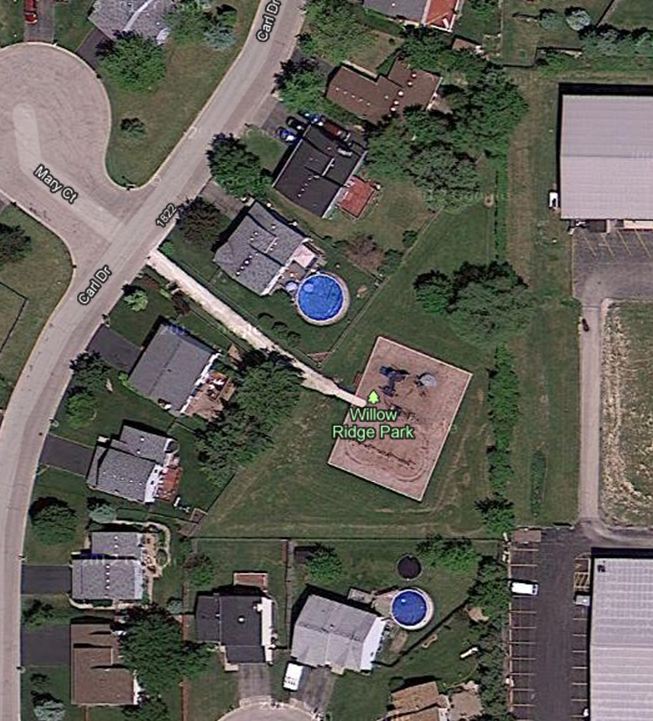
Take a look below at “Willow Ridge Park”, a “pocket park” in the Willow Ridge subdivision (south of Country Walk). The builder was able to “donate” land for this park, a rather  awkward triangle of property. Rather than the Village insisting on decent design and land-use from the developer, all eyes were on the $$$ of property-tax and sales revenue from future residents.

The view to the east (through a rusty chain-link fence) is to a gravel-covered above-ground propane tank, its encircling driveway, and two monolithic (and rather boring) buildings in the industrial park… and their dumpsters. (Doesn’t that just want to make you play?) Oh, and only one way in/out of the park.
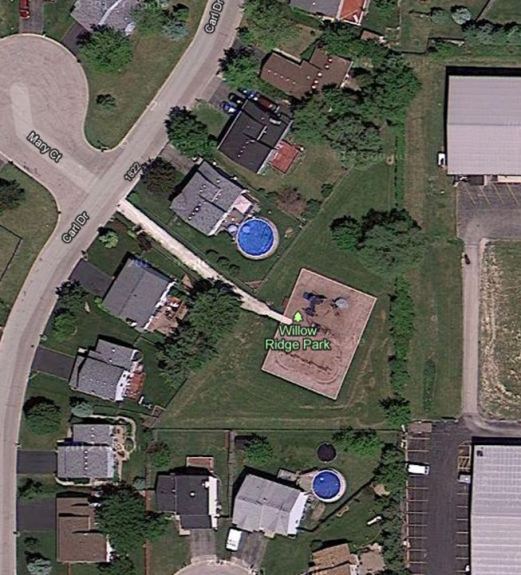
Willow Ridge Park in Round lake Beach

Willow Ridge Park in RLB

What else makes this less/low value? From the aspect of how we humans view things, as a universal standard, the front of a private property is considered its “public” face, whereas the back is considered “private” space. If you’ve ever been in one of these parks where you’re staring into the backyards of all the surrounding homes, you’ve somehow felt almost like you’re intruding; the experience is less than welcoming and inviting. The “outdoor room” in the rear of each home is also that much less private as well, where sunbathing, gardening, hanging clothes to dry… everything… is everyone else’s business. Forever.

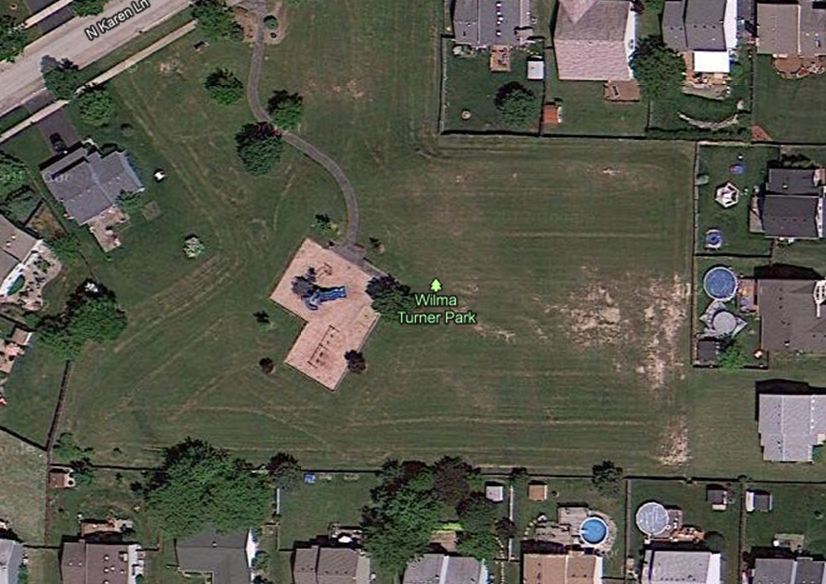
Below is “Wilma Turner” Park… same situation. Greatly underutilized space. All its potential wasted to be mostly a grassy lot with a gym set. (We’ve lived near both of these parks for 14+ years, and have raised a son here in RLB… we are speaking from experience!)  Like the park above, there is only ONE way in; to have a much-needed measly 10′ right-of-way for access between homes on the opposite side is simply out of the question!
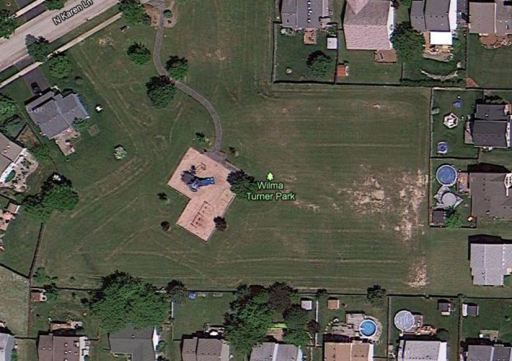
Wilma Turner Park in Round Lake Beach

Wilma Turner Park in RLB

“Now the good news: if you design the open space as parks, greens, squares, plazas, and playgrounds, and if you put them in front of the houses rather than behind, you can create a great deal of value.”

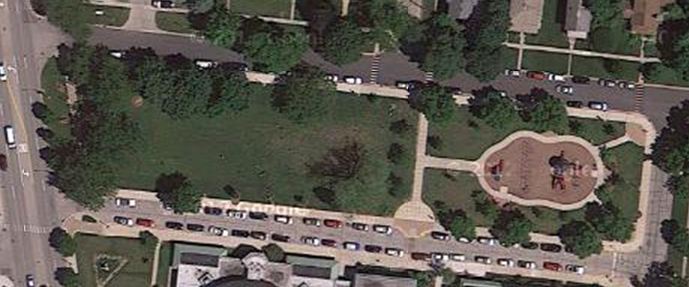
So check out THIS park in Liberyville, where it is designed (planned?) as a public amenity for the residents, not as an afterthought. It exists in its own defined space, accessible from ALL sides. It FEELS public, and is made easy to get to. Value is created by having a vibrant WELL-USED green space out the front windows of all the homes surrounding the space. One space, shared by all in a meaningful way.
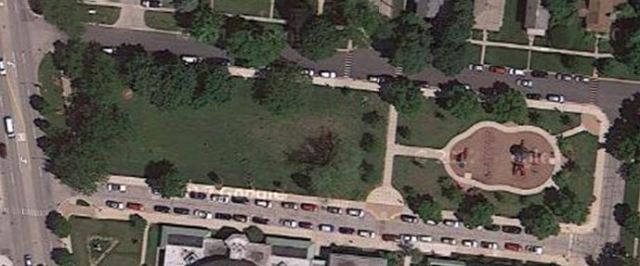
Public Park in Libertyville Illinois

Public Park in Libertyville IL

“A long view across a space significantly wider than a street increases the real estate value of all buildings facing the long view, usually by 25% or more. Turn the fronts of the houses to the view with a street (or occasionally a walk) running between the houses and the view, and you carry that value up to two blocks deep into the adjacent urbanism because those people can walk to the long view as well.

   That increase in real estate value can almost immediately pay for the land given up for parks, greens, squares, plazas, and parks. Over the long term, as the neighborhood is built out, it builds a reputation of being one of the more desirable places in town, cementing the resilience of that value. These principles apply both to new neighborhood design and also to sprawl recovery.”

As we look at what we can do to increase the real and perceived values of this village we call home, remember some of these factors at work. There is not a lot of undeveloped land remaining in RLB, and it’d be a hard-sell with current mindsets to devote a chuck of real estate to something which doesn’t directly appear to generate any revenue.

What can we do to make our parks more useable and accesible? Have we asked the users lately? Some of the older parks are nothing but fields surrounded by chain-link fence… inviting? What would it take to bring YOU out more often and use parks for what parks  are intended to be?  

Link to full article: “Generous Urbanism”

Posted in Children, Parks, Planning, Walkability | Leave a comment

Farmers Markets & Low-Income Communities

“Will we ever get a Farmers’ Market here in the Round Lake area?”

We hear that question a lot, and will continue to explore that over several posts like this one, which deals with a common mis-perception about the cost of goods purchased at Farmers’ Markets.

“In 2009, the Project for Public Spaces (PPS), in partnership with Columbia University, undertook a study to examine what market characteristics successfully attract low-income shoppers. The study also explored the obstacles that may prevent low income individuals from shopping at a farmers market when one existed nearby.

We were able to identify two key trends.

– First, we found that price is not a barrier. Among the survey sample, almost 60% of farmers market shoppers in low-income neighborhoods believed their market had better prices than the grocery store. Among those who did not shop at farmers markets, only 17% cited price as a barrier to shopping at their local farmers market.

– Second, we learned that information is key. Unlike a grocery store, markets typically lack permanent structures and are therefore more ephemeral by nature. Shoppers need better access to information about schedules and seasonal changes in order to become more regular market shoppers.”

It is the first finding that gets us motivated on the idea of establishing a Market here. Once it gets going, a substantial portion of the customers believe they’re getting more for their dollars at their Market; that certainly can drive the repeat business which is vital to keep the vendors returning.

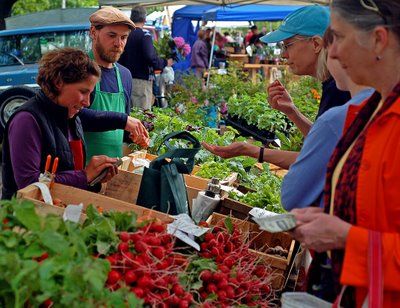
– Our area contains the second-poorest demographic in Lake County (behind Waukegan/N. Chicago), the ability of our low-income residents to purchase fresh,  healthy food with minimal travel expense and at-or-below grocery store prices would certainly be a win/win: we get a multi-use “place” (even if only for 4-hours/week), another “destination” is created for shoppers coming to our villages, local growers have an outlet for their goods, and residents get affordable, healthy food!

Farmers Market

Farmers Market

There were four main recommendations based on the findings in this study (which you can download  [.pdf] and review for yourself). A major consideration for setting up a Market in our area is:

Location, Location, Location A common reason cited by non-market shoppers for not patronizing a farmers market was the need to complete their shopping at one location… market operators who are serious about long term sustainability turn their market into a DESTINATION. The market should not only be a place to buy produce, but should incorporate programming that integrates the market into the fabric of the surrounding community.” [Sounds like Place-Making, doesn’t it?]

We love the idea of establishing a Farmers’ Market in the Round Lake area. It does need to be placed somewhere with easy access, ample parking (but no more than a short walk TO the market), and the difficult part: a reason to be where it is, someplace where life happens and people would already be active (or, if it is done correctly, could be the spur to drive the creation of such a place).

“Markets are wonderful public gathering spaces that put an emphasis on community health. They make it easier for people to make better dietary choices, while simultaneously bringing neighbors together to form the strong, supportive social networks that are critical to success in leading healthy lifestyles in the long term.”

Link to: “New Report on Farmers Markets & Low-Income Communities

Link to .pdf report: “Farmers Markets as a Strategy to Improve Access to Healthy Food for Low-Income Families and Communities

Posted in Economics, Farmers' Markets, Local Food Production, Planning | Leave a comment

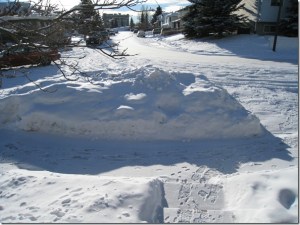
Snowy cul-de-sacs cost more in city services

Now that the snow has finally arrived, this article [.pdf] in “Milwaukee Magazine” might be of interest for those of us living in the newer part of town on the north side.

At some point we have all experienced the effects of traveling through a neighborhood with curly-cue streets and dead-end cul-de-sacs, but there are additional costs when design / engineering  doesn’t focus on connectedness:

Dead End“: Growing evidence suggests the cul-de-sac costs more in city services.

[Jerry Schaefer, Franklin WI  Superintendent of Public Works reports  that:] “A plow can generally clear six to eight traditional streets in the time it takes to deal with one cul-de-sac, which is a 90-foot asphalt circle (on average) comprised of hazards seen and unseen. Operators must carefully locate nooks to pile snow safely and without generating a homeowner complaint.

Counting 16 houses – eight per side – on a straight, block-long street in an average low-density subdivision, a plow will clear streets directly serving 96 to 128 homes in the same time needed for one cul-de-sac.”

“A cul-de-sac takes longer, by far,” says Schaefer. “You could easily plow a mile of street in the time you spend on a cul-de-sac.”

“From a public works perspective, they’re significantly less efficient and significantly more costly to maintain than a normal grid of streets.”

As we look at how to make Round Lake Beach an even better place to live, we should understand how the Codes, Ordinances, and Zoning we count on to help us sometimes make it too easy to say “Yes!” to the wrong things.

MORE (.pdf / Adobe Acrobat)

Link: Milwaukee Magazine

Posted in Construction / Maintenance, Economics, Planning | Leave a comment

“As land use planning changes, ‘zoning’ is no longer appropriate”

If you’ve read anything in this blog yet, you’ve quickly discovered that we’re not big fans of “Zoning”, legislating land use based on function or use, and then only single-use at that.

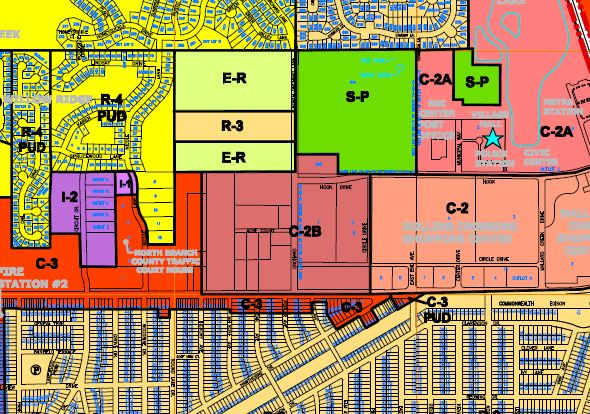
Zoning Map of RLB's "Central Commercial" area...

Zoning Map of RLB’s “Central Commercial” area…

Fortunately, there is a rapidly-spreading awareness of everything we’ve lost, the inefficiencies we’ve built-in to our environment, and all the resources we’ve wasted over the years by substituting zoning for actual planning. Suburban denizens expecially have been aware for decades that something about the design and arrangement of their villages wasn’t quite right, but didn’t even have the vocabulary to describe the problem.

Now, thanks for the maturing discipline of “Sprawl Repair“, we know not only what is wrong but have a proven toolbox of techniques to fix it.

This article by Roger K. Lewis (a practicing architect and a professor emeritus of architecture at the University of Maryland) examines this need for the shift away from “modern” zoning and the many benefits of doing so.

“Principles and methods of land use planning, transportation, regulation and real estate development are changing, as are demographics and social norms. Zoning conventions are no longer conventional.

Fortunately, mixed-use development is at last beginning to supersede single-use development, especially to make new or revitalized areas more walkable. No one proposes building factories in the middle of residential neighborhoods. But today’s master plans, despite current zoning, increasingly envision communities that encompass not only diverse housing types but also retail shops and stores, restaurants, offices, cultural destinations and recreational facilities.

Linked to density are increased building heights in appropriate locations and on sites that make urban design and architectural sense. Places exist in cities, towns and suburbs where higher buildings can become iconic landmarks, better enclose civic spaces, take advantage of favorable views and topography and contribute to activating streetscapes. Owing to greater tax receipts, higher buildings and denser development also yield fiscal benefits.

Zoning usually requires parking to serve each discrete use as if each use stood alone. But differences in parking demand timing can lower parking needs. At night, residents can park in empty spaces designated for retail and office during the day. During weekdays when retail and office parking demand is high, as is retail weekend demand, many residents are away. Thus, in the aggregate, some spaces can serve double duty.

Dropping the word “zoning” necessitates using an alternative vocabulary. It’s time to talk less about zoning restrictions and limits and more about visionary plans, urban design goals and architectural aspirations.”

Link to entire Washington Post article: As land use planning changes, ‘zoning’ is no longer appropriate”

Posted in Bicycling, Economics, Planning, Transit, Walkability | Leave a comment

Upcoming Webinars: “Economic Impact of Women Bicyclists” and “Promoting Cycling and Walking”

… and the kicker is that both of these (while free) are scheduled for the same day and the exact same start time a week from now!
Q: Are any of our local village officials making use of these free resources?

Webinar #1. “The Economic Impact of Women Bicyclists”
Wednesday, Feb 27, 1pm CST

A free webinar by the “League of American Bicyclists“, as part of their Women Bike series. Details and link to registration HERE.

bike women

Webinar #2: “Promoting Cycling and Walking for Sustainable and Healthy Cities: Lessons from Europe and North America
Wednesday, Feb 27, 1pm – 2:30pm CST

John Pucher, a professor in the School of Planning and Public Policy at Rutgers University in New Jersey and visiting professor at the University of North Carolina at Chapel Hill, has spent more than three decades studying the difference in travel behavior and transport systems and policies in Europe, Canada, the USA, and Australia.

Pucher’s presentation will discuss policies and programs needed to make cycling and walking safe and convenient; how Dutch, Danish and German cities get nearly everyone, including women, children and seniors, on bikes for a wide range of trop purposes; and what communities in the United States can do to increase walking and bicycling while also making them safer and more convenient for everyday travel to work, school and shopping.

Details and online registration HERE.

Posted in Bicycling, Economics, Meeting / Webinar, Walkability | Leave a comment

“Lighter, Quicker, Cheaper” Works!

Here’s another example of what can happen when the people actually living and working in a place get to decide what to do with it!

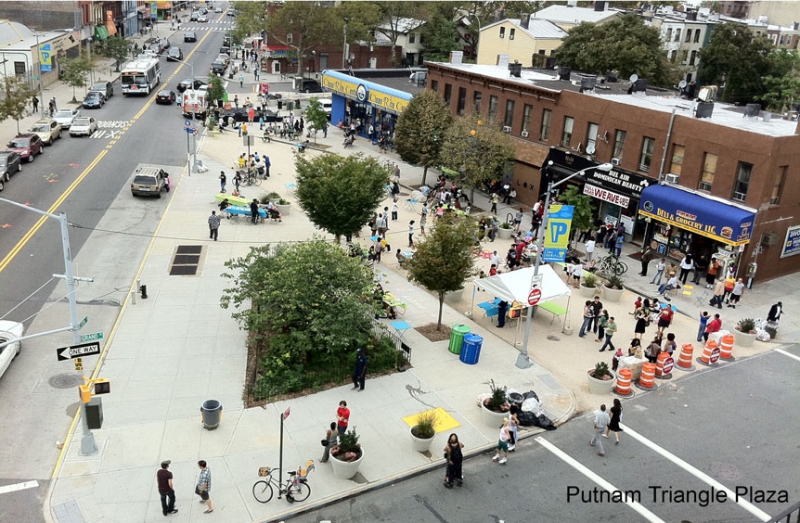
The Department of Transportation (DOT) approved the Fulton Area Business (FAB) Alliance’s application to make the plaza permanent, forever closing off Putnam Avenue between Grand Avenue and Fulton street to any traffic other than pedestrian… … the development will pave the way for a build-out of the new space, based on community input.

"Available for use by the entire community, the Putnam Triangle Plaza is a spot where you can soak up the sun, read a paper, eat lunch, do some work, play a few games of chess or hold your own event."

“Available for use by the entire community, the Putnam Triangle Plaza is a spot where you can soak up the sun, read a paper, eat lunch, do some work, play a few games of chess or hold your own event.”

The plaza, installed by the DOT, celebrated its opening in September 2012 with a FAB Alliance-hosted block party, complete with music, art, dancing and activities for the kids.

Though the news of the plaza’s permanence comes is welcomed by many, some residents and business owners initially expressed concerns with the space, saying it would stop the “currents of the streets” and negatively impact businesses.

Check out that quote about concerns of stopping the “currents of the street”. That happens a lot when you try new things, especially with “place making” concepts. Change is difficult for a lot of people; vision is even more challenging.

Starting with a “What if?” by a couple of the local business owners, followed by some patio chairs, portable planters, pop-up canopies and traffic barrels, the “users” of this space, previously used only for cars, created value and place. They did so inexpensively, and they did so from the “bottom-up”. Didn’t take a big-budget study (or big-budget at all).

“Lighter, Quicker, Cheaper” (LQC) works wonders as a practical place-making tool! Where could we “experiment” in Round Lake Beach… how about a couple of places near eateries so we finally have some outdoor eating & gathering spots?

Article Link: Putnam Triangle Plaza Made Permanent

Posted in Economics, Planning | Leave a comment

Webinar: Child and Age-friendly Communities (Fostering communities as if ALL people mattered)

Webinar: Child and Age-friendly Communities (Fostering communities as if all people  mattered)
When: Fri, Feb 15, 2013 12:00 PM – 1:30 PM CST
Presenter: Mildred Warner , Lydia Morken , Dorian Block
Host: American Planning Association, the Ohio Chapter
Cost: Free

An aging population and the ‘browning’ of America are creating demand for communities that are friendly to all generations and ethnicities.  Multi-generational planning uses smart growth principles to create livable communities that deliver places that help young and old remain active, connected and thriving in place.

Real progress will occur with a paradigm shift if generations work together and cultural imperatives are addressed. This session will highlight both research and on-the-ground experience in multi-generational planning.

GoToMeeting Online Registration Link

Posted in Children, Community, Meeting / Webinar, Planning, Seniors | Leave a comment

Suburbia and the American Dream

This article most certainly is in the category of “If you can only read a couple of posts, make this one of them”!

Article Link at Strong Towns: Suburbia and the American Dream

Suburban sprawl, characterized by enormous houses, big-box stores, massive park­ing lots, and high-traffic multi-lane roads, is in conflict with the tradi­tional wisdom about the connection between the built environment and the moral order. This doesn’t mean that all people who live in suburbia are somehow morally deficient, or that those who live in cities are angels. But there is, nevertheless, a relationship between the places we build and how we flourish as human beings.

The suburbs came to represent habits of materialism and isolation. Middle-class families left urban neigh­borhoods for larger, more secluded homes on the city outskirts, where drive­ways pushed homes away from the street and garages replaced the semi-public realm of front porches. Few suburbs had a clear neighborhood center. For the first time, it was easy and inexpen­sive to live, work, shop, learn, and pray in places that were miles apart. Because of the automobile, communities could now be physically separated from deeply rooted social bonds, places of worship, and civic institutions.

We find it easier to drive to a big-box store for all our needs than to patronize smaller local stores. Most of us are not yet willing to give up a 2,400 square-foot house with a giant front lawn, especially if we have chil­dren. We can’t imagine living any other way, though many of our grandparents raised families larger than our own in homes half the average size of a modern suburban house. Well-meaning parents have bought into the faulty idea that sprawl is necessarily better for raising and educating children.

Citizens and municipal governments alike are learning that sprawl is no longer fiscally sustainable and that there must be alternative ways to build. The price of gasoline and expense of car ownership underscore the practical value of mixed-use, walkable neighborhoods. The high cost of building and maintaining roads and infrastructure means low-density suburbs with lower land values take on so much debt from building sprawl that the payments last longer than the lifetime of the improvements.

In some cities, Form-Based Codes now address problems created by con­ventional zoning. They allow mixed-uses, require main street buildings to be closer to the street, deal with parking more sensibly, and ensure that build­ings aren’t too big for the neighbor­hood’s character. The small successes of the New Urbanist movement are knit­ting back together the threads of com­munities whose fabric was torn apart in the last century.


Posted in Construction / Maintenance, Economics, Planning | Leave a comment